



What are custom chrome car emblems & badges?
Using the principle of electrolysis, a thin layer of metal (such as nickel, chromium, or gold) is plated onto the surface of a substrate such as metal or plastic, giving the small sign a metallic luster while also making it more wear-resistant and corrosion-resistant. Examples include car rear badges, body lettering badges, ABS plastic electroplated car badges, or metal nameplates on electronic devices.
Advantages of chrome ABS badges plastic emblems
* It gives plastic products a metallic luster, making them aesthetically pleasing and decorative;
* It improves the mechanical strength of the product surface and extends its service life;
* It gives plastic products higher stability against external factors such as light and atmosphere, making them less prone to aging;
* It gives plastic electrical conductivity, magnetic permeability, and weldability.
Chrome ABS Badges Plastic Emblem Process
* The main process flow of ABS plastic electroplating is as follows:
* Hanging, chemical degreasing, roughening, neutralization, palladium activation, desizing, chemical nickel plating, pre-nickel plating, acid bright copper plating, semi-bright nickel plating, bright nickel plating, microporous nickel plating, chromium plating, and drying.
1. Degreasing:
* The main purpose of degreasing is to remove oil and grease, while reducing surface tension and imparting hydrophilicity to the surface. During processing or transportation, parts inevitably come into contact with oil, mold release agents, and other impurities. These factors affecting subsequent operations must be removed through degreasing. Degreasing also plays a role in promoting uniform roughening, improving coating adhesion, and extending the service life of the roughening solution.
2. Roughening: The purpose of roughening is to increase surface roughness and surface area, thereby increasing the adhesion between the metal plating and the plastic; it also changes the plastic surface from hydrophobic to hydrophilic, ensuring uniform wetting of all parts by water to facilitate the uniform adsorption of metal ions. Roughening methods include mechanical roughening, solvent swelling roughening, and chemical roughening.
3. Sensitization: The purpose of sensitization is to adsorb a layer of easily oxidized substances onto the surface of the workpiece, so that a redox reaction can occur during activation treatment, forming a catalytic noble metal film on the workpiece surface.
4. Activation: The purpose of activation is to first form a metal film on the surface of the workpiece (adsorbing catalytic substances such as gold or copper onto the sensitized surface), which serves as a catalyst for the subsequent chemical deposition, facilitating chemical plating.
Activation treatment involves immersing the workpiece, which has adsorbed a reducing agent, into a solution containing an oxidizing agent. Generally, this is immersion in an aqueous solution of noble metal salts, whereby the noble metal ions are reduced to noble metals by the reducing agent, thus forming a noble metal film on the workpiece surface. This precious metal layer acts as an active catalyst, also known as a catalytic film, accelerating the reduction reaction in electroless plating. Practice has shown that metals such as gold, silver, copper, and palladium possess this catalytic ability.
5. Electroless Plating: After activation treatment, the surface of the workpiece already has a thin layer of silver or other metal film. If immersed in an acidic solution, the silver film will peel off. Therefore, alkaline electroless copper plating is required first. Through a redox reaction, a layer of copper is plated onto the workpiece surface to strengthen the conductive layer. Then, electroplating can be performed in an acidic medium. Electroless plating is a low-temperature autocatalytic reduction reaction. After electroless plating, the workpiece enters the conventional electroplating process, and it can be electroplated like a metal part.
6. Post-treatment: After electroplating, the metal coating needs post-treatment to improve its quality and appearance. Generally, post-treatment includes cooling, cleaning, and polishing.
7. Quality Inspection: Finally, after electroplating, the product needs quality inspection. This mainly checks the thickness, adhesion, and surface quality of the plating layer. Only products that pass quality inspection will be packaged and shipped.

Chrome ABS Badges & Emblems Development Prospects:
With the continuous development of automotive lightweighting technology, plastics have become the most widely used lightweight non-metallic material. The widespread application of electroplating not only gives plastic parts a metallic appearance and texture, improving the aesthetics and comfort of automotive components, but also enhances the mechanical properties and chemical stability of plastic parts, enriching the applications of plastics in automobiles.
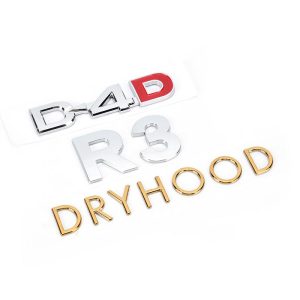
Electroplating of automotive plastics promotes the replacement of metallic materials and accelerates the process of automotive lightweighting. Blended modified plastics and fiber-reinforced plastics are increasingly widely used in automobiles due to their excellent performance. The preparation of electroplating-grade materials and the improvement of electroplating processes will be key to the development of plastic surface metallization technology.
Chrome ABS Badges Car Emblem
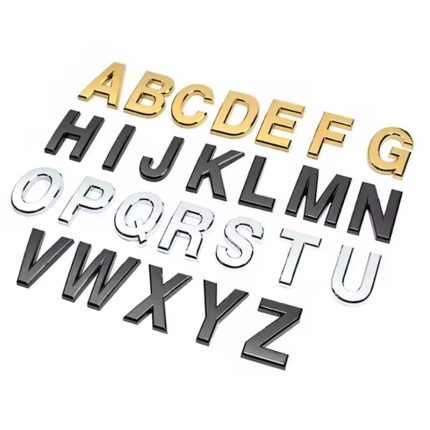
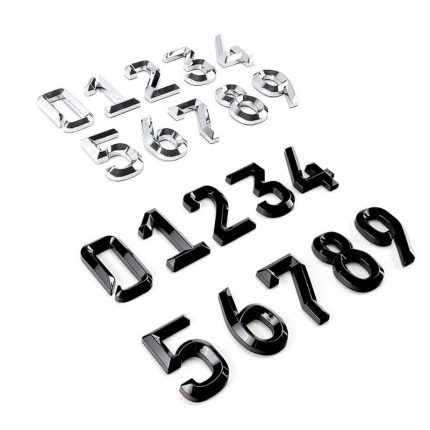
Who Makes Custom Chrome Emblems?
Our factory is located in Yiwu, China. We specialize in Chrome ABS Badges & Car emblems more than 15 years. All electroplated products can be customized with low MOQ, high grade quality and quite effective for stores, cars, hotels, bars, company, supermarket, 4s showrooms etc.